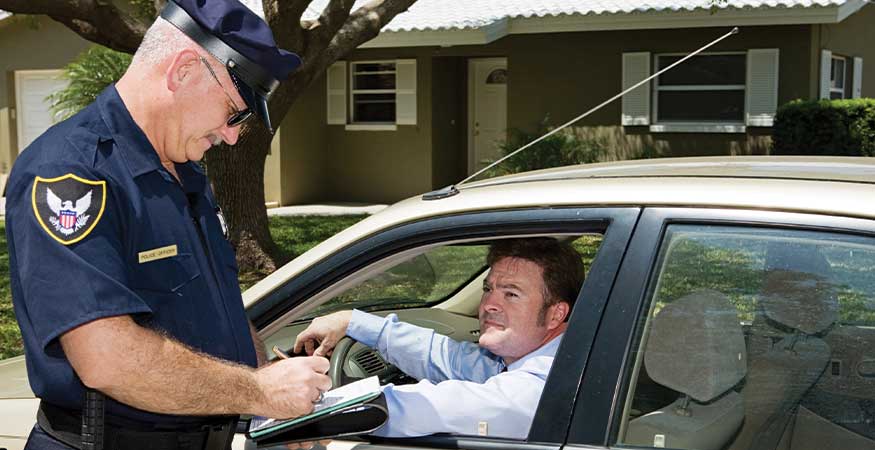
Stopped for ‘Weaving’ Once: Is That Enough for Reasonable Suspicion?
Being stopped by police for weaving just once inside a lane may not be enough to justify a traffic stop in Colorado. Under the Fourth Amendment, drivers are protected from unreasonable searches and seizures, meaning officers need specific, observable facts to establish reasonable suspicion of a traffic violation or criminal activity. Isolated movements, like a single lane drift without touching the lines, generally do not meet this legal standard. Understanding how courts evaluate weaving, patterns of erratic driving, and video evidence from dashcams or body cameras is crucial for anyone facing DUI or traffic-related charges, as challenging an unlawful stop can significantly impact the outcome of a case.

What Constitutes Reasonable Suspicion in Traffic Enforcement
Police officers cannot rely on intuition or “gut feelings” to initiate a traffic stop. The law requires specific, observable facts that a reasonable person could identify and explain. Officers must document concrete behaviors, not assumptions or hunches.
When Weaving Alone Isn’t Enough
A vehicle drifting once or twice within a lane typically does not justify a stop. Courts consider multiple factors, including:
- Number of times the car crossed lane markings
- The distance the vehicle drifted from its lane
- Causes of the movement (potholes, debris, pedestrians, intentional lane changes)
- Road and weather conditions (ice, rain, construction zones)
- Time and location of the driving behavior
To establish reasonable suspicion, police must demonstrate that observed behavior indicates illegal activity or impairment. Small lane corrections or brief drifts often reflect normal driving, not intoxication or recklessness. The Fourth Amendment protects drivers from stops based on weak evidence or officer assumptions.
Courts evaluate the totality of circumstances: a single lane touch is very different from repeated swerving, erratic speed, or near-collisions. Valid, reasonable suspicion requires linking observable driving behavior to specific traffic violations, signs of impairment, or other legitimate safety concerns.
The Legal Definition of “Weaving Within a Lane”
To understand what police officers see during traffic stops, we need to know what the law says is illegal. Traffic laws separate two different things: illegal lane changes and normal movements inside one lane. The main legal question is whether staying inside your lane lines means an officer has no valid reason to pull you over.
Most state traffic laws say you must actually leave your lane for police to cite you for a violation. Courts now recognize that no driver stays perfectly centered in their lane at all times. This is true on curved roads, in windy conditions, and during normal highway driving. Defense attorneys point out that when drivers keep their vehicles between the lane markers, they have not broken any traffic law. Police officers who claim a driver appears impaired based only on movement within the lane face challenges in court. Lawful driving behavior, even when the vehicle position varies, cannot by itself give officers legal grounds to conduct a traffic stop under the Fourth Amendment protection against unreasonable searches and seizures.
Circuit Court Split: Diverging Standards Across Federal Jurisdictions
Federal appeals courts have made conflicting rules about police stops for weaving inside lane lines. These different rules mean a driver’s Fourth Amendment rights depend on location instead of constitutional law. The Fourth Amendment protects citizens from unreasonable searches and seizures by government officials.
Some circuit courts allow police to stop vehicles when drivers briefly cross lane markers. These courts accept police officer statements that quick weaving creates reasonable suspicion of drunk driving or traffic violations. Reasonable suspicion means specific facts that suggest criminal activity might be happening.
Other circuit courts require police to point to more facts beyond one instance of weaving. These courts recognize that drivers cannot stay perfectly centered in lanes at all times. Minor lane movements happen during normal, legal driving.
This split between jurisdictions creates an unfair situation. The same driving behavior allows a legal stop in Texas but violates constitutional rights in Ohio. A jurisdiction is the geographic area where a specific court has authority to make decisions.
The Supreme Court has refused to settle this disagreement between circuits. This refusal allows random enforcement to continue. The Constitution requires reasonable suspicion to rest on objective, standard facts that apply the same way in every state. Courts should not apply different rules based on regional preferences.
The circuit split affects millions of traffic stops each year. Police officers in states under permissive circuits can stop vehicles for minimal weaving. Police officers in states under restrictive circuits need additional suspicious factors like erratic speed, wide swerving, or other dangerous behaviors.
This inconsistency undermines public trust in constitutional protections. Citizens cannot know which driving standards apply when traveling across state lines. The lack of uniform standards also makes it harder for police departments to train officers on proper traffic stop procedures.
The Fourth Amendment Framework for Traffic Stops
When police officers pull over drivers, the Fourth Amendment requires them to have reasonable suspicion. This means officers need specific facts that suggest a person broke the law or violated traffic rules. Officers cannot rely on gut feelings or vague observations.
The Supreme Court case, Terry v. Ohio, set the standard. Officers must identify clear circumstances that justify stopping someone and limiting their freedom. The facts must be objective, things that other people could observe and verify, not just the officer’s personal impression.
“Weaving” stops create constitutional problems. When an officer stops a driver for moving slightly within their lane or crossing a line once, this raises questions about whether reasonable suspicion exists. A single lane deviation might show normal driving behavior: adjusting position, avoiding road debris, or responding to weather conditions. These movements do not necessarily indicate drunk driving or reckless operation.
Courts have a duty to examine whether the observed driving behavior actually suggests illegal activity. This examination matters because traffic stops disproportionately affect minority communities and low-income neighborhoods. Research shows that vague standards like “weaving” give officers wide discretion that can lead to unequal enforcement patterns.
The Fourth Amendment protects citizens from unreasonable government intrusion. This constitutional protection means minor vehicle movements should not automatically give police authority to seize someone. Officers need to observe conduct that genuinely indicates a traffic violation or criminal behavior—not just any deviation from perfect lane maintenance.
The threshold for reasonable suspicion must remain meaningful to preserve individual liberty and prevent arbitrary stops.
The Role of Lane Departure Degree and Duration
Judges reviewing weaving stops must examine two key factors: how far a vehicle left its lane and how long it stayed outside the proper position. Small departures—where tires briefly touch or cross a lane line—rarely show impaired driving. Regular drivers sometimes drift without breaking traffic laws.
Large weaving patterns that last longer give police stronger reasons for stops. Officers must describe specific details, not just general statements. The Fourth Amendment requires precise facts. How many inches did the vehicle cross the line? For how many seconds did the weaving continue? Over what distance on the roadway did this happen? General words like “weaving” or “drifting” do not provide enough detail for constitutional stops.
Defense lawyers should question stops that lack exact measurements. They should demand objective facts rather than personal opinions from officers. Courts now understand that modern lane-keeping systems show how often legal drivers make small lane adjustments. This technology data proves that single departures do not automatically mean impairment. One lane touch does not justify stopping a vehicle under Fourth Amendment protections.
The degree of measurement matters. A vehicle crossing six inches over a line differs from crossing two feet. The duration measurement matters too. Touching a line for one second differs from weaving for thirty seconds. The distance measurement provides context. One lane departure in fifty feet of travel differs from five departures in the same distance.
These concrete measurements separate lawful driving behavior from reasonable suspicion of criminal activity.
Additional Factors That Strengthen or Weaken Reasonable Suspicion
Police officers often point to extra observations beyond lane departures to justify traffic stops. These additional factors need careful examination, not automatic acceptance by courts.
Weak Factors That Should Not Support Stops:
Claims like “driving late at night” or “traveling through a high-crime area” should not turn insufficient weaving into legal grounds for a stop. Courts must require specific details. Officers must answer concrete questions: Did the driver’s speed actually change in erratic patterns, or did the vehicle simply travel five miles below the posted limit? Did the car come within inches of striking a curb, or did it maintain a safe distance throughout the maneuver?
Vague Descriptions That Lack Meaning:
General descriptions like “the driver appeared nervous” or “seemed overly cautious” often show officer assumptions rather than real signs of impaired driving. The time on the clock cannot turn lawful driving into suspicious behavior. A person has the constitutional right to drive at 2:00 AM just as they do at 2:00 PM.
What Defense Attorneys Should Challenge:
Defense lawyers should question whether these supplementary factors truly show signs of impairment. They should ask if officers added these observations after the stop to justify a decision already made. The Fourth Amendment protects citizens from stops based on hunches or profiles rather than specific, articulable facts that indicate criminal activity.
The Constitutional Standard:
Each observation must connect logically to impaired driving or traffic violations. Generic factors that apply to thousands of law-abiding drivers cannot meet the reasonable suspicion threshold required by the Constitution.
Time of Day, Location, and Contextual Circumstances
Police officers often use time and place to justify a weak suspicion when they stop someone. They say things like “late at night” or “high-crime area” without explaining what these phrases mean in the specific situation. Courts need to make officers explain exactly why the time matters, not just repeat general statements about when drunk drivers are on the road.
When officers describe a neighborhood as dangerous, they must provide real evidence. This evidence includes crime statistics from police records, recent incidents that happened nearby, or specific conditions they can see right then. Labels alone don’t count as evidence. A car drifting slightly in its lane doesn’t become suspicious just because the clock shows 2:00 a.m. or because the street sits in a certain neighborhood.
These time and place factors can add to the actual traffic violations an officer sees. But time and location by themselves cannot turn legal driving into reasonable suspicion. The Fourth Amendment of the U.S. Constitution protects all citizens in every place, at any time. The amendment doesn’t care what time the clock shows or what address appears on the street sign.
Officers must base their decisions to stop citizens on specific facts they observe, not on assumptions about times and places. A person following all traffic laws has the right to drive through any neighborhood at any hour without police interference. The Constitution requires more than “it was late” or “it’s a bad area” to justify stopping someone.
State-by-State Variations in Weaving Stop Standards
The Fourth Amendment to the United States Constitution protects all Americans from unreasonable searches and seizures by law enforcement. Each state court system interprets what counts as “weaving” using different legal standards. This creates confusion for drivers about their constitutional rights during traffic stops.
| State Approach | Weaving Standard | Example States |
| Strict | Police must observe multiple lane departures; one weave does not justify a stop | Minnesota, Wisconsin |
| Moderate | Officers need weaving behavior combined with other suspicious factors | Florida, Pennsylvania |
| Permissive | Police can stop drivers after observing a single weave | Kansas, some federal circuits |
These different standards create serious problems for legal consistency. A driver who weaves once while traveling through Minnesota commits no traffic violation that justifies a police stop. That same driver performing the identical action in Kansas gives police officers reasonable suspicion to initiate a traffic stop and investigation. This state-by-state variation allows police departments to use minor driving behavior as justification for stops that may target specific individuals or groups.
States using permissive weaving standards give police officers broad authority to stop vehicles. Officers can transform ordinary driving patterns, momentary steering adjustments that every driver makes, into grounds for criminal investigation. A driver who crosses from one state into another faces different levels of Fourth Amendment protection without knowing the legal standards have changed. This reality conflicts with the principle that constitutional rights should apply uniformly across all American jurisdictions.
Challenging a Traffic Stop Based on Insufficient Reasonable Suspicion
When police officers stop a vehicle without reasonable suspicion, the driver has a constitutional right to challenge that stop. The exclusionary rule protects this right by throwing out any evidence gathered during an illegal stop. This protection can destroy the prosecutor’s entire case.
Reasonable suspicion requires specific facts that make an officer believe a law is being broken. An officer cannot rely on hunches or feelings. The Fourth Amendment to the United States Constitution protects people from unreasonable searches and seizures, including traffic stops.
How a Criminal Defense Attorney Can Challenge Questionable Traffic Stops
Defense attorneys use several methods to question whether a traffic stop was legal:
- Review video evidence from dashboard cameras and body cameras
Video recordings show what actually happened during the stop. Lawyers compare this footage against what the officer wrote in the police report or said in testimony. If the video shows the car driving normally, but the officer claimed the driver was weaving badly, this contradiction weakens the stop’s justification.
- Question the officer’s judgment and observations
Lawyers ask detailed questions about what the officer saw. Important factors include:
- How far away was the patrol car from the stopped vehicle
- What time of day did the stop occur
- What were the weather and road conditions
- How much training does the officer have in detecting impaired driving
- Did other vehicles on the road drive the same way
- Study similar court cases from the same area
Different courts and jurisdictions set different standards for what counts as reasonable suspicion. Some appellate courts have ruled that minor weaving within a single lane does not justify a stop. Defense lawyers find these relevant cases to show judges that the stop violated established legal standards.
- File motions to suppress evidence before trial
A suppression motion asks the judge to exclude evidence because police violated constitutional rights. If the judge grants this motion, the prosecutor often cannot prove the case and must dismiss the charges.
Judges must examine whether officers had specific, describable facts supporting the stop. Vague statements like “the driver looked suspicious” or “the car was weaving” are not enough. Officers must explain:
- How many times has the vehicle crossed lane markers
- How far over the line the vehicle went
- How long did the irregular driving lasted
- What other traffic violations occurred
The Exclusionary Rule and the Fruit of the Poisonous Tree Doctrine
The Fourth Amendment protects drivers from unlawful police stops. When a traffic stop violates this constitutional right, the exclusionary rule requires courts to suppress all evidence obtained during the stop. The fruit of the poisonous tree doctrine extends this protection: any evidence discovered as a direct or indirect result of an illegal stop is also inadmissible in court.
Think of it like a tree: if the roots—the initial stop—are illegal, then all the fruit—the evidence gathered from that stop—is tainted and cannot be used in court.
Examples of Suppressed Evidence After an Illegal Stop
- Field sobriety tests → suppressed
- Breathalyzer or chemical test results → suppressed
- Officer observations → suppressed
- Contraband or illegal items → suppressed
- Statements or admissions → suppressed,
Defense attorneys in Colorado often challenge stops based solely on minor weaving or other trivial movements. Courts evaluate whether officers had a genuine, reasonable suspicion or used minor infractions as excuses for a pretextual stop. When stops lack proper legal justification, any resulting evidence may be completely suppressed, protecting drivers’ constitutional rights and sometimes leading to dismissal or reduction of DUI charges.
How Dashboard and Body Camera Footage Impacts Weaving Cases
Video evidence has changed everything in weaving cases. Dashboard cameras and body cameras record what really happened during a traffic stop. This recorded proof either backs up what the police officer says or shows something different. The technology stops officers from claiming things happened when they didn’t.
Defense lawyers use this video footage to fight traffic stops by showing:
- Small lane touches that don’t prove someone was driving dangerously
- Regular steering adjustments that officers wrongly called suspicious weaving
- Differences between police reports and what the video actually shows
- Road problems like potholes, debris, or construction zones that made drivers move their vehicles
Courts now expect to see video proof when cameras were available. When prosecutors can’t show clear video evidence that supports what the officer claimed to see, judges often rule the traffic stop was illegal. This means any evidence collected after the stop—like DUI test results or drug discoveries—gets thrown out of court.
The presence of recording devices protects both citizens and law enforcement officers. Video documentation creates an accurate record of traffic violations, officer conduct during stops, and driver behavior. This objective evidence eliminates guesswork about what happened on the road. Legal professionals, judges, and juries can watch the actual event instead of choosing between competing stories.
Police departments that use dashboard cameras and body cameras build stronger cases when violations actually occurred. Defense attorneys who obtain this footage can prove their clients’ innocence when officers made mistakes or exaggerated normal driving patterns.
Practical Guidance for Drivers and Defense Strategies
Rights During Traffic Stops
The Constitution gives drivers important protections when police officers pull them over. The Fourth Amendment stops illegal searches. The Fifth Amendment means no one has to answer questions that might get them in trouble.
Drivers should stay calm and polite with officers. They can choose not to answer questions about drinking alcohol or where they traveled. When an officer asks to search a car, drivers can say no. Saying no to a search does not give police a legal reason to search anyway.
In states where recording is legal, making a video or audio recording creates a permanent record of what happened.
Defense Attorney Strategies
Attorneys defending clients must look closely at whether one small swerve really gave police enough reason to make a traffic stop. Defense attorneys should request all dashcam footage, bodycam video, and nearby security camera recordings.
Officers sometimes give unclear descriptions of what they saw. Lawyers need to question these vague statements in court.
Expert witnesses who understand road design, car mechanical problems, and normal driving patterns can show when police make questionable stops. A traffic stop might be a pretext—an excuse to investigate something else without real evidence.
The key legal goal is proving the officer lacked reasonable suspicion. Reasonable suspicion means specific facts that make an officer think a law was broken.
Without reasonable suspicion, the traffic stop violates constitutional rights. When a judge agrees that the stop was illegal, all evidence collected after that stop cannot be used in court. This includes breath tests, field sobriety tests, statements the driver made, and anything found in the vehicle.
Share This Story, Choose Your Platform!
Table of Contents
- What Constitutes Reasonable Suspicion in Traffic Enforcement
- Circuit Court Split: Diverging Standards Across Federal Jurisdictions
- The Fourth Amendment Framework for Traffic Stops
- The Role of Lane Departure Degree and Duration
- Additional Factors That Strengthen or Weaken Reasonable Suspicion
- Time of Day, Location, and Contextual Circumstances
- State-by-State Variations in Weaving Stop Standards
- Challenging a Traffic Stop Based on Insufficient Reasonable Suspicion
- The Exclusionary Rule and the Fruit of the Poisonous Tree Doctrine
- How Dashboard and Body Camera Footage Impacts Weaving Cases
- Practical Guidance for Drivers and Defense Strategies
My World changed dramatically in September 2017. I had never been in any sort of trouble with the law and now I was being cited for a DUI. I was scared, nervous, and had no idea what to do. I made the choice to contact an attorney, and DUI Law Firm Denver information was sent to me by a friend. I called Emilio right away to discuss my case.
The very first time we talked Emilio took almost an hour to listen to what was happening and offered specific recommendations to help me battle through this process. At that point I decided to hire Emilio and we began a long, almost 6 month journey, to resolve the issues surrounding this DUI.
Faced with very few options to help me mitigate my impending punishments, DUI Law Firm Denver never gave up helping me to fight as hard as we could for the best possible outcome in court. He made suggestions along the way that I truly believe turned the tides of this case. To the very end he stood beside me, believed in my story, and fought to help me in any way he could, even though he was pressed against a pretty solid wall.
At the end of it all, given what could have happened, I was very satisfied to come out of this with hope for a brighter future. I am taking the steps necessary to get back on track and without Emilio’s help I would have been doomed to a much greater punishment.
Related Reading

Commercial Driver DUI in Colorado: CDL-Specific Penalties and Defenses Commercial drivers in Colorado operate under two layers of regulation: state DUI laws and federal transportation rules. Together, these systems impose far stricter standards and penalties than those faced by regular drivers. A commercial driver can lose their CDL with a blood alcohol content of just [...]
Denver vs. Suburban DA Practices: Plea Policy Differences in DUI Cases DUI cases in the Denver metro area can unfold very differently depending on where an arrest occurs. Since 2005, the Denver District Attorney’s Office has maintained a strict policy against reducing DUI charges to lesser offenses, while nearby counties—including Jefferson County, Colorado, Arapahoe County, [...]
Under-21 DUI in Colorado: Zero-Tolerance Rules and Defenses Colorado has some of the strictest underage drinking and driving laws in the country. Under the state’s Zero Tolerance Law, drivers under 21 can face criminal charges with a blood alcohol concentration (BAC) of just 0.02%, an amount that may result from even minimal alcohol consumption. An [...]