Colorado DUI Checkpoints This Summer: Your Legal Rights at the Roadblock
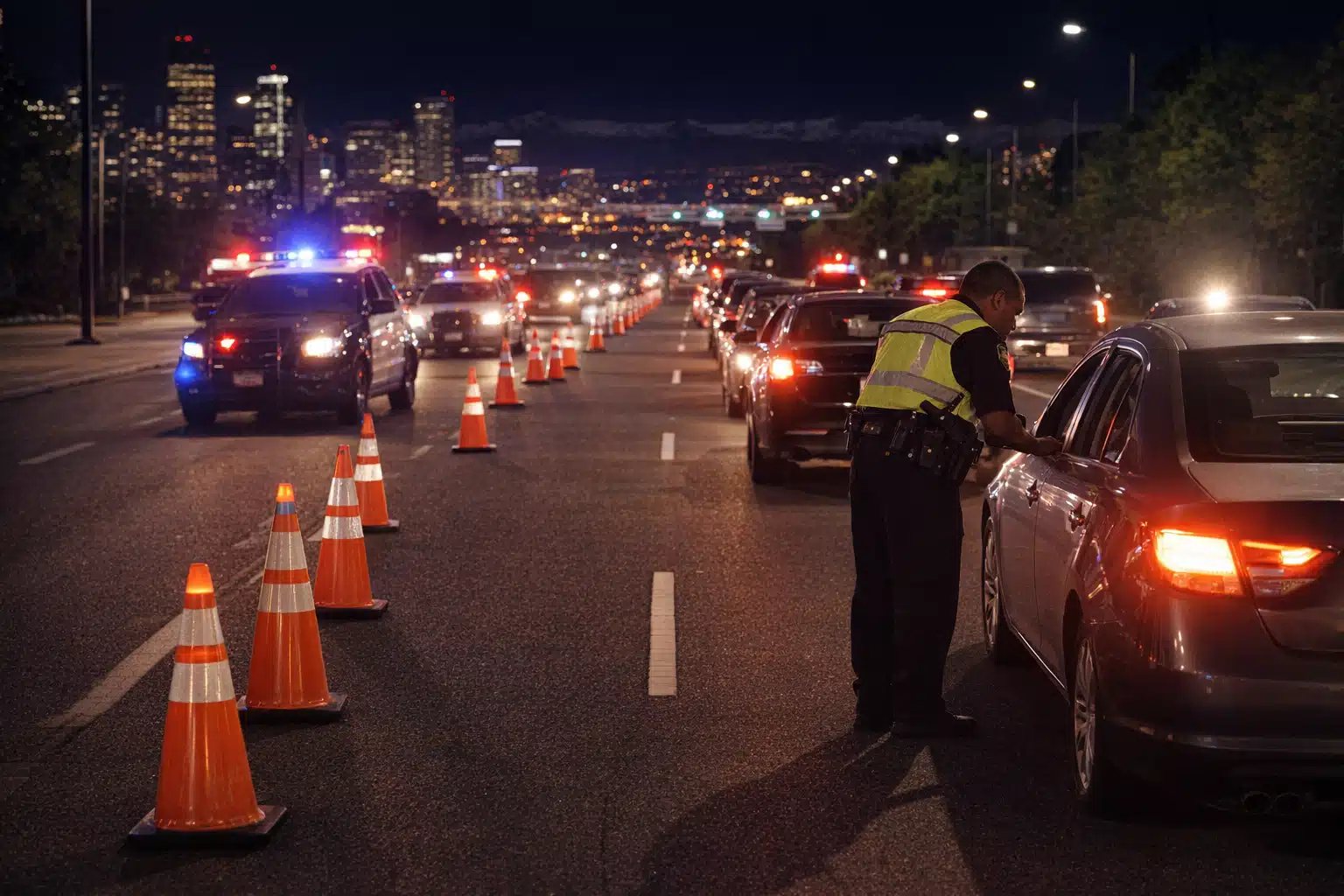
Colorado DUI checkpoints are legal when police follow strict protocols, and drivers retain constitutional protections including the right to stay silent beyond basic identification and decline voluntary roadside tests.
- You must provide license, registration, and insurance but may decline questions about drinking or where you have been. Roadside sobriety tests are voluntary, but refusing a chemical test after arrest triggers license consequences under Express Consent law.
- Checkpoints can be challenged if police lacked supervisory approval, used non-neutral stopping formulas, or detained drivers too long. A defense attorney can review protocol violations that may lead to suppressed evidence.
- After a checkpoint DUI arrest, you have only 7 days to request a DMV hearing to contest license suspension. Two separate cases proceed - one criminal and one administrative.
At a Colorado DUI checkpoint, you have the right to remain silent beyond providing your license, registration, and insurance. You can decline to answer questions about where you have been or whether you have been drinking. You may also refuse field sobriety tests and portable breath tests without automatic penalties, though refusing a chemical test after arrest carries license consequences.
At a Colorado sobriety checkpoint, you keep clear constitutional protections. Knowing your Colorado DUI checkpoint rights helps you respond calmly and avoid mistakes that hurt your defense later.
Summer brings more roadblocks across the Denver metro area. You may hit one on Colfax, near Coors Field after a Rockies game, or on I-25 during a holiday weekend.
This article covers what officers can require, what you may decline, and when a checkpoint may be legally flawed. Every case differs, and the notes below are educational, not legal advice for your situation.
Are DUI Checkpoints Legal in Colorado?
DUI checkpoints are legal in Colorado when police follow strict rules. The U.S. Supreme Court upheld sobriety checkpoints in Michigan v. Sitz (1990).
Colorado courts allow them because the state’s interest in stopping impaired driving outweighs a brief, minimal stop. But that permission comes with conditions.
A valid checkpoint usually must meet standards such as:
- Advance supervisory approval, not officer discretion in the field
- A neutral formula for which cars get stopped (for example, every third vehicle)
- Reasonable safety measures, lighting, and signage
- Limited detention time for each driver
- Some public notice before the operation
When police ignore these rules, evidence gathered at the stop may be challenged. That distinction matters more than most drivers realize.
Your Colorado DUI Checkpoint Rights at the Roadblock
You retain your Fourth and Fifth Amendment protections at a checkpoint. A roadblock does not erase your right against unreasonable searches or your right to stay silent.
Can You Legally Turn Around to Avoid a Checkpoint?
Yes, in many cases you may turn around before a checkpoint if you do so lawfully. Avoiding a roadblock is not, by itself, a crime.
The problem starts when the turn involves a traffic violation. An illegal U-turn, crossing a double yellow line, or an abrupt lane change gives police a separate reason to stop you.
Example: a driver on Federal Boulevard sees a checkpoint and makes a legal turn onto a side street. That maneuver alone should not justify a stop.
But if that same driver swerves across two lanes without signaling, the officer now has grounds. The lawful exit matters.
What You Must Provide
You must provide your license, registration, and proof of insurance when asked. Refusing to hand over these documents can create separate legal trouble.
You must stop when directed and follow basic lawful commands. Cooperation with identification does not mean answering every question.
What You May Decline
You may decline to answer questions about where you have been or whether you have been drinking. You have the right to stay silent beyond basic identification.
A polite response works: “Officer, I prefer not to answer questions.” Stay calm and avoid arguing.
You may decline roadside sobriety tests, such as the walk-and-turn or one-leg stand. Colorado treats voluntary roadside tests differently from the chemical test after arrest.
Roadside Tests vs. Chemical Tests: Know the Difference
Not all tests carry the same consequences in Colorado. Confusing them leads to costly mistakes.
- Roadside field sobriety tests: Voluntary. Declining them carries no automatic license penalty.
- Preliminary breath test (PBT) at the scene: Also voluntary for most drivers over 21.
- Chemical test after arrest (Express Consent): Different rules apply. Refusal triggers license consequences.
Colorado’s Express Consent law requires drivers lawfully arrested for DUI to complete a breath or blood test. Refusing the post-arrest chemical test can lead to a license revocation and a “persistent drunk driver” designation.
That refusal decision affects both your Colorado DMV case and your criminal case. Speaking with a lawyer about breath tests and blood tests before making choices helps you weigh the stakes.
DUI vs. DWAI in Colorado
Colorado charges two main alcohol-related driving offenses. The difference comes down to how much impairment the state must prove.
- DUI: Driving under the influence, when alcohol or drugs substantially affect your ability to drive safely. A blood alcohol level of 0.08 or higher supports a DUI charge.
- DWAI: Driving while ability impaired, when alcohol or drugs affect your driving to the slightest degree. This applies at levels as low as 0.05.
Checkpoint stops can lead to either charge. Marijuana DUI cases also arise at summer roadblocks, and those involve their own testing questions.
How Checkpoint Evidence Can Be Challenged
Evidence from a checkpoint may be suppressed when police fail to follow required protocols. A defense lawyer reviews every step of the operation.
Points a defense attorney may examine include:
- Was there written supervisory approval? Field officers cannot set up a lawful checkpoint on a whim.
- Did police use a neutral stopping formula? Random or profiling-based stops raise constitutional problems.
- Was the stop reasonably brief? Extended detention without cause can violate your rights.
- Was your extended detention justified? Moving you to secondary screening needs specific, articulable facts.
- Were the roadside tests administered correctly? Poor instructions or uneven surfaces affect reliability.
When a step breaks down, a judge may exclude the resulting evidence. That can reshape a DUI defense or DWAI defense case.
Common Mistakes Drivers Make at Denver Checkpoints
Small missteps at a roadblock create larger problems later. Awareness helps you stay composed.
- Volunteering that you had “a couple of drinks”
- Arguing or becoming hostile with officers
- Making an illegal turn to avoid the stop
- Assuming roadside tests are mandatory
- Refusing the post-arrest chemical test without knowing the license impact
Politeness and silence beyond identification protect you. You can assert your rights without confrontation.

 Posted on Google
What Happens After a Checkpoint DUI Arrest
A DUI arrest in Colorado starts two separate cases. One is criminal, handled in Colorado courts. The other is administrative, handled by the Colorado DMV.
Steps that usually follow include:
- Arrest and chemical test under Express Consent law.
- License action: You have 7 days to request a DMV hearing to fight a suspension.
- Criminal charges filed in the county where the stop occurred.
- Arraignment and pretrial motions, including any challenge to the checkpoint.
- Resolution: plea negotiation, dismissal motions, or trial.
The 7-day DMV deadline surprises many people. Missing it can cost you the chance to contest your license suspension.
An ignition interlock device may become part of restoring driving privileges. Requirements differ for a first-time DUI, a repeat DUI, or an underage DUI.
Preparing for a Summer Sobriety Checkpoint in Denver 2026
Preparation lowers your risk of a bad interaction. A summer sobriety checkpoint Denver 2026 season will likely bring more patrols around holidays and events.
Practical steps to stay ready:
- Keep your license, registration, and insurance easy to reach
- Plan a ride if you drink at all
- Stay calm and roll down your window at the stop
- Provide documents; decline further questions politely
- Write down details right after any stop or arrest
Your memory of a summer sobriety checkpoint Denver 2026 encounter fades fast. Notes about timing, signage, and officer conduct help your lawyer later.
When to Contact a Colorado DUI Attorney
Contact a lawyer as soon as possible after a checkpoint arrest. The 7-day DMV window and early evidence review both reward fast action.
A defense attorney can request checkpoint records, assess protocol violations, and handle DMV hearings. Criminal defense strategy depends on facts an experienced lawyer knows to look for.
Laws change, and each case turns on its own details. General articles cannot replace advice about your specific stop.
Conclusion
You keep real constitutional rights at a Colorado checkpoint, including the right to turn around lawfully, stay silent beyond identification, and decline voluntary roadside tests. Checkpoint evidence can be challenged when police skip required protocols, and the 7-day DMV deadline demands quick action.
If police stopped you at a Denver checkpoint, act promptly to protect your license and defense. Contact DUI Law Firm Denver for a confidential consultation at 303‑404‑7492, text 303‑404‑7492, or email info@DUILawFirmDenver.com.
Sources
- Justia – Michigan Dept. of State Police v. Sitz, 496 U.S. 444 (1990)
- Colorado Division of Motor Vehicles – DUI and Express Consent
- Colorado General Assembly – Colorado Revised Statutes
- National Highway Traffic Safety Administration – Drunk Driving
Share This Story, Choose Your Platform!
Table of Contents
When I received my DUI, it was one of the toughest challenges I had to face. I knew I needed an experienced criminal law attorney to help get me through the court process. After meeting with Emilio and his entire team I knew I was in great hands. Their knowledge about the law combined with years of experience made me feel extremely confident going though this difficult time. The DUI Law Firm team walked me through every step in a timely fashion, never leaving my side, making it a successful outcome. I am extremely grateful for what they had accomplished for me.
Related Reading

A missed DUI court date in Colorado can turn a defendable case into an arrest situation overnight. The judge may issue a bench warrant the same day you fail to show up. Acting within hours, not days, gives you the best chance to limit the damage. Maybe you wrote down the wrong date. Maybe you [...]
After a Colorado DUI, the court and the Colorado DMV both expect you to complete alcohol education before your case fully closes. Colorado DUI alcohol education classes are court- and probation-ordered programs that follow a required alcohol and drug evaluation. That evaluation decides how many hours of class and therapy you must finish. Imagine a [...]
Your first DUI court appearance in Denver is a hearing called an arraignment, where you formally learn the charges against you and enter a plea. If you were arrested near Speer Boulevard on a Friday night, you may have left jail with a pink summons listing a court date at the Lindsey-Flanigan Courthouse. That single [...]