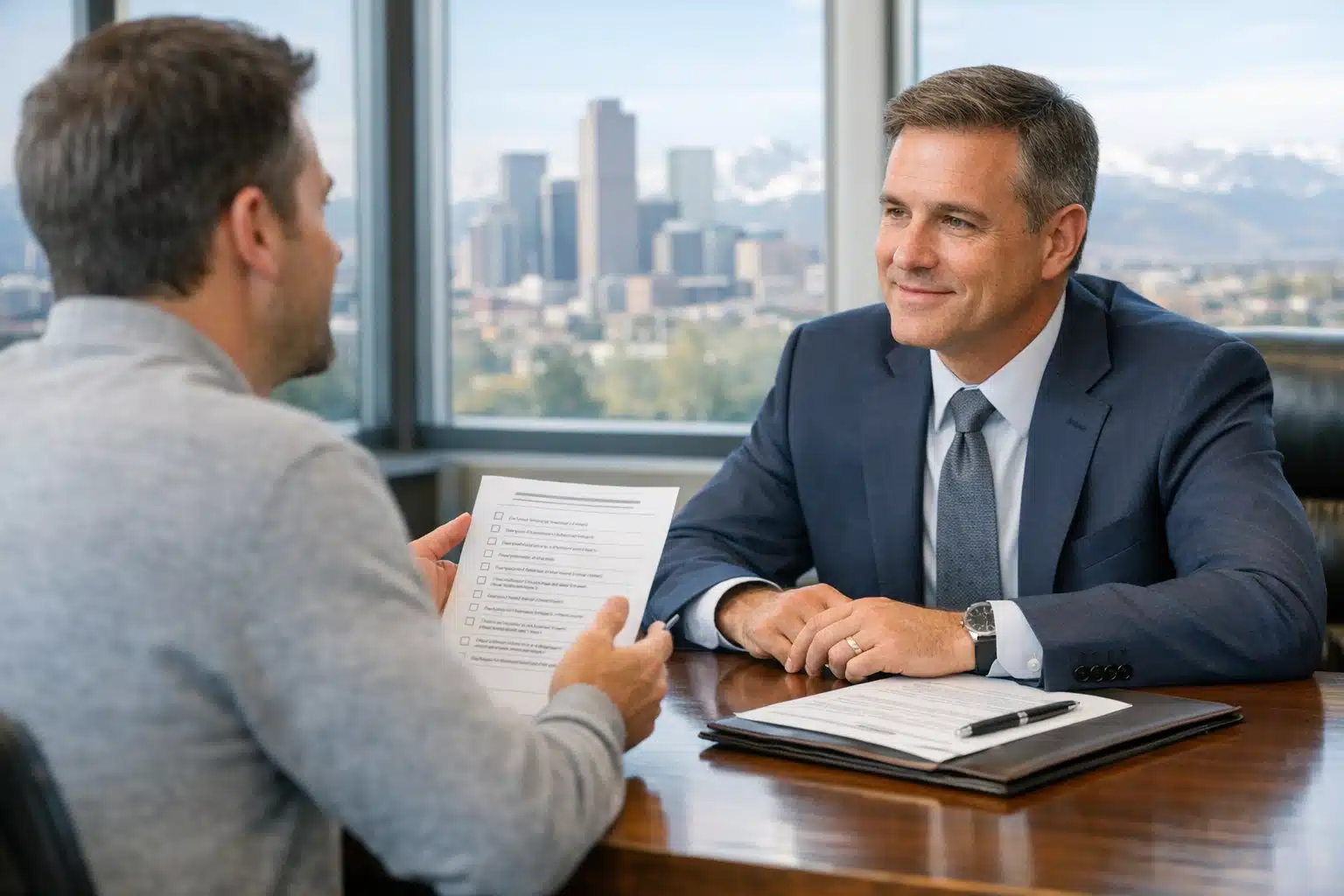
What to Bring to Your First Meeting With a Denver DUI Attorney: A Preparation Checklist
After a DUI arrest in Denver, the single most useful thing you can do is gather your paperwork before your first meeting with a DUI attorney in Denver. The documents in your hands often decide how much an attorney can tell you on day one.
Many people walk into a first meeting DUI attorney Denver consultation empty-handed, then spend the hour recalling details instead of reviewing evidence. This checklist keeps that from happening to you.
Below you will find the exact DUI consultation documents to collect, why each one matters under Colorado law, and the deadlines that make acting quickly worthwhile.
Why Your First Meeting With a DUI Attorney in Denver Matters So Much
A Colorado DUI arrest starts two separate cases at once. One moves through the Colorado courts. The other moves through the Colorado Division of Motor Vehicles.
The DMV case runs on a short clock. You have seven days from your arrest to request a hearing to protect your driving privileges.
Miss that window, and your license suspension begins automatically on the eighth day after the notice. Bringing the right paperwork to your first meeting lets an attorney flag that deadline immediately.
The Preparation Checklist: DUI Consultation Documents to Bring
Gather the items below and place them in one folder. If you cannot find something, bring what you have and note what is missing.
- Your citation or summons and complaint
- The pink DMV notice (Express Consent Affidavit and Notice of Revocation)
- Bond paperwork and any release conditions
- Your Colorado driver’s license or ID
- Any police reports or body camera references you received
- Breath or blood test results, if provided
- Your written notes about the night
- Proof of your next court date
- A list of prior DUI or DWAI convictions, if any
- Insurance and employment details that a suspension could affect
Each item tells a different part of your story. The next sections explain what each one reveals.
1. Your Citation or Summons and Complaint
This document lists the charges Colorado filed against you. It shows whether you face a DUI, a DWAI, or both.
DWAI is a Colorado offense that applies when alcohol or drugs affect your driving to the slightest degree. A DUI applies when you are substantially incapable of safe driving.
The citation also lists your first court date and the filing county. An attorney reads it to confirm where your case lives and what statutes are involved.
2. The Pink DMV Notice
Colorado officers usually take your physical license and hand you a pink document. That paper doubles as a temporary permit and a warning.
It contains the seven-day deadline to request a DMV hearing. Bring this to your first meeting so your attorney can calendar the request before time runs out.
This single page is the one most people forget. Without it, protecting your driving privileges becomes harder.
3. Bond Paperwork and Release Conditions
If you posted bond, you received paperwork listing your conditions of release. Some conditions bar alcohol use or require monitoring.
Violating a bond condition can create a new problem on top of the DUI. Your attorney needs to see exactly what the court ordered.
4. Breath or Blood Test Results
Colorado uses the Express Consent law. By driving, you agreed to chemical testing when lawfully arrested for DUI.
You chose either a breath test or a blood test. Each type carries different review angles.
- Breath tests use machines like the Intoxilyzer and produce results on-site
- Blood tests go to a lab, take longer, and create a physical sample for retesting
If you have not received results yet, say so. Your attorney can request them during the case.
5. Your Written Notes About the Night
Memory fades fast after a stressful arrest. Write down what you recall before your first meeting.
Useful details include where you were stopped, what the officer said, and which field sobriety tests were requested. Note the weather, the roadside conditions, and any health issues that affected your balance.
These notes help an attorney evaluate the traffic stop and the testing. Small facts frequently matter in a DUI defense.
6. Prior DUI or DWAI History
Colorado treats repeat offenses more harshly than a first-time DUI. Penalties climb with each prior conviction.
A fourth DUI in Colorado becomes a felony. Bring an honest list of any past alcohol or drug driving convictions, including those from other states.
This information shapes the strategy from the start. Hiding it only weakens your defense.
Court Case vs. DMV Case: Why You Bring Papers for Both
The two cases run on different tracks with different rules. Bringing documents for each lets your attorney address both in one sitting.
- Colorado courts: handle the criminal charge, fines, probation, and any jail exposure
- Colorado DMV: handles license revocation, reinstatement, and ignition interlock requirements
An ignition interlock device is a breath-testing unit wired to your car’s ignition. Colorado requires it for many drivers restoring privileges after a revocation.
Your attorney maps both tracks during the first meeting. The right paperwork makes that map accurate.
What to Expect During Your First Meeting DUI Attorney Denver Consultation
The meeting is confidential. What you share stays protected by attorney-client privilege.
Here is how a first meeting usually unfolds:
- You hand over your documents and notes
- The attorney reviews the charges and deadlines
- You describe the stop, the arrest, and the testing
- The attorney explains the court and DMV tracks
- You discuss realistic defense directions for your facts
- You review fees and next steps together
Every case is different, and laws change. An attorney cannot promise a result, but can explain what your paperwork shows.
Common Mistakes People Make Before the First Meeting
A few avoidable errors weaken an otherwise strong position. Steer clear of the ones below.
- Throwing away the pink DMV notice and missing the seven-day hearing request
- Discussing the arrest on social media, where statements can be used against you
- Waiting weeks to speak with an attorney after the arrest
- Forgetting to list prior convictions from other states
- Assuming a refusal has no consequence under Colorado’s Express Consent law
Refusing a chemical test can trigger a longer license revocation. Bring any refusal paperwork so your attorney understands the full picture.

 Posted on Google
Special Situations to Flag Early
Some circumstances change the analysis. Mention them at the first meeting if they apply.
Marijuana DUI cases involve THC blood levels and different scientific questions than alcohol cases. Colorado sets a permissible inference level for THC, but the science is contested.
Underage DUI carries its own lower thresholds. Drivers under 21 face penalties at much lower blood alcohol levels.
If a crash, injury, or child passenger was involved, say so. Those facts raise the stakes and the strategy.
How Quickly Should You Schedule the First Meeting?
Schedule within a few days of your arrest. The seven-day DMV deadline leaves little room to wait.
Early review gives an attorney time to request a DMV hearing and preserve evidence. Body camera footage and dispatch logs do not stay available forever.
Acting promptly protects both your license and your defense. That is the practical reason this checklist exists.
Conclusion
Bring your citation, the pink DMV notice, bond papers, test results, and honest notes to your first meeting with a DUI attorney in Denver. That folder lets an attorney spot deadlines, read the charges, and explain your court and DMV tracks in one sitting.
Colorado’s seven-day DMV window rewards fast action, and every case turns on its own facts. For a confidential consultation, contact DUI Law Firm Denver at 303‑404‑7492, email info@DUILawFirmDenver.com, or visit https://duilawfirmdenver.com.
Sources
Share This Story, Choose Your Platform!
Table of Contents
Firstly, I would like to thank DUI Law Firm Denver for successfully representing me in my Adams County DUI case. The level of experience, scientific knowledge, dedication (I had both Emilio and Trevor representing me), and preparedness made all the difference during my trial. I highly recommend them. They are the BEST!
Related Reading

The single most useful thing you can do after a Denver DUI arrest is ask the right questions before you sign a fee agreement. In Colorado, you have only 7 days to request a DMV hearing to protect your license, and the attorney you pick affects both that hearing and your criminal case. Knowing the [...]

Many people in Colorado are concerned about protecting the privacy of their smartphone data. While the Fourth Amendment safeguards against unreasonable searches, interacting with law enforcement can still be complicated. Police must follow legal rules to access your phone, but there are practical steps you can take to keep your information secure. Understanding how to [...]
Courts in Colorado often rely on no-contact order monitoring systems to ensure individuals follow the restrictions set by the judge. These systems use technology such as GPS ankle bracelets, electronic monitoring tools, and specialized software that can immediately alert law enforcement if a violation occurs. By tracking a person’s movements, authorities can confirm whether they [...]